
01
Create a complete job before asking recruiters to fill it
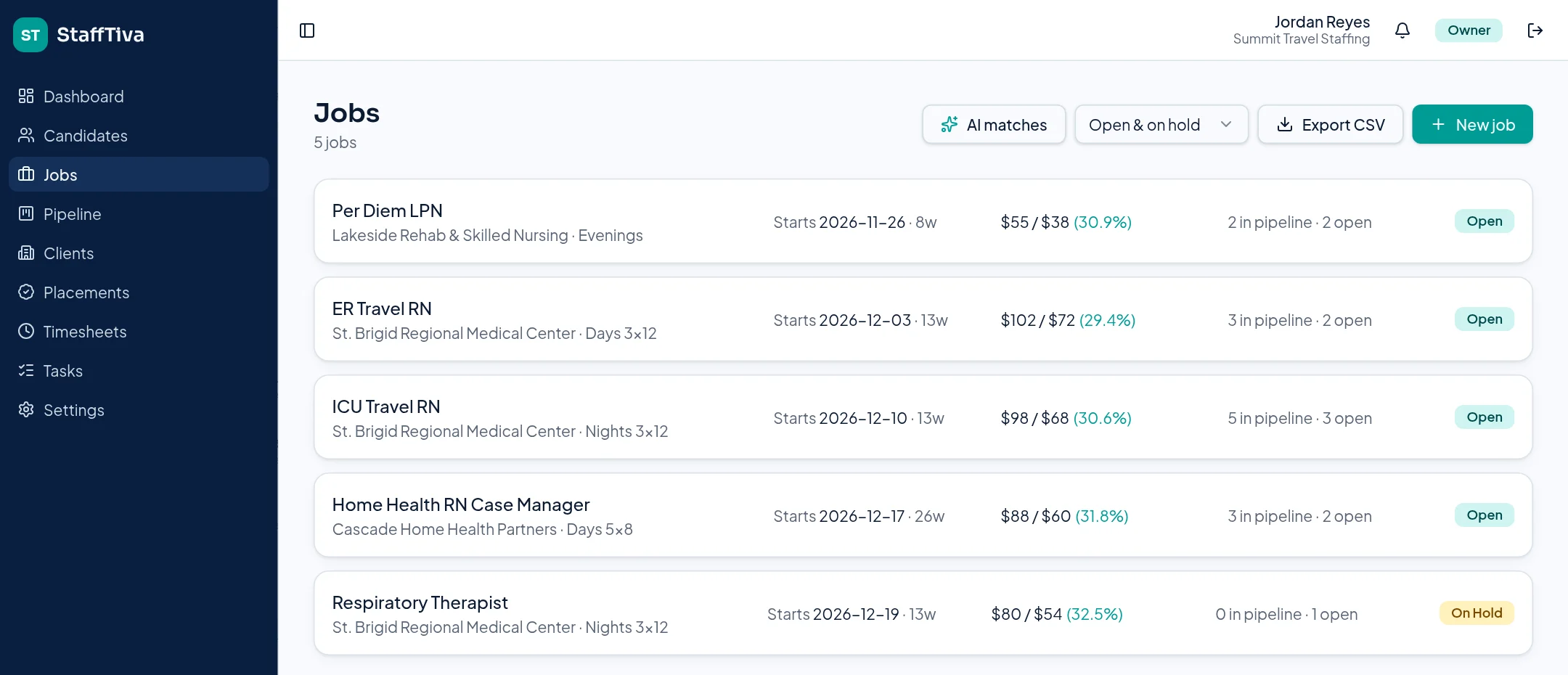
Link the order to the client and record title, discipline, specialty, shift, start and end dates, openings and required credentials. These fields provide the minimum context for a relevant shortlist. Confirm unclear dates or requirements with the account manager before asking clinicians to consider the opportunity.
Two requests from the same facility may need different rates and documentation. Separate job orders preserve those differences and keep candidate submissions attached to the correct staffing need rather than a generic facility vacancy list.
02
See the rate spread while the terms are being set
StaffTiva calculates hourly gross margin as bill rate minus pay rate, and margin percentage as that spread divided by bill rate. At an illustrative $100/hour bill rate and $70/hour pay rate, the spread is $30/hour and 30%. This gives the team a consistent commercial reference while reviewing an order.
The calculation is before payroll taxes, benefits, travel, housing and other operating costs. It is not take-home profit. If either rate is missing, resolve that gap before using margin to compare the order with another assignment.
03
Keep submissions and openings in the same view
Each order has a pipeline from Sourced through Placed. Recruiters can compare candidate progression with the number of openings and review the job’s specific credential requirements before submitting. Tasks linked to the job keep account questions and client follow-up close to the recruiting work.
The public agency job board exposes safe applicant-facing information, not the facility name or client bill rate. That lets your agency receive applications without publishing sensitive commercial details from the internal order.
04
Carry the order into assignment management
Placement records preserve candidate/job relationships, dates and rates beyond the accepted offer. End-date and extension status tracking help teams review upcoming coverage gaps. The three-week extension reminder provides a prompt for a client and clinician discussion, not an automatic extension.
Owners can then review placement activity and estimated client margin on the dashboard. Monthly estimates use a 36-hour weekly assumption, so teams managing irregular coverage should review actual placement hours and costs separately.
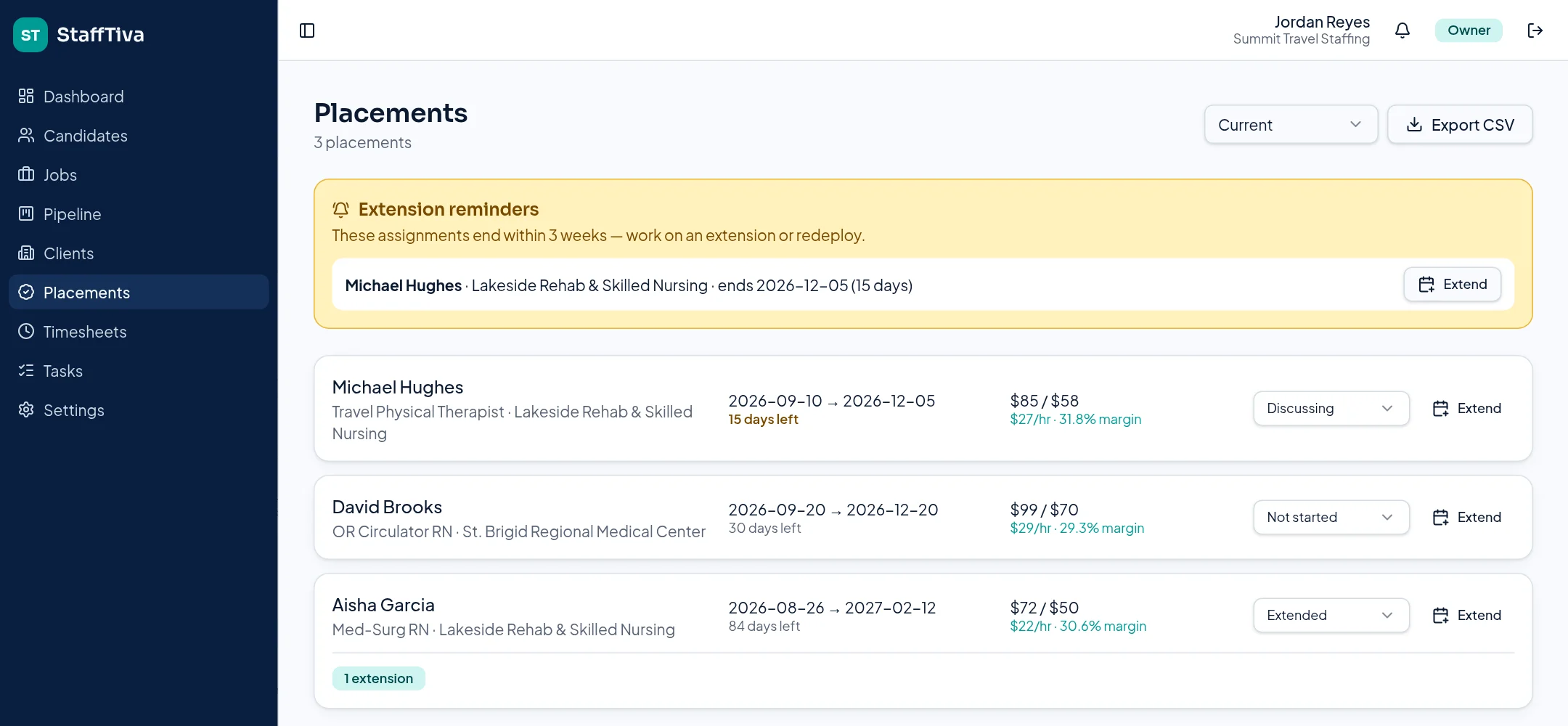
Placements continue the job order workflow with assignment dates, rates and extension status. StaffTiva demo agency.
Questions & answers
How is job gross margin calculated?
Hourly margin is bill rate minus pay rate. Margin percentage is that spread divided by bill rate; for $100 bill and $70 pay, it is $30/hour and 30% before other costs.
Can each order have a different credential checklist?
Yes. Required credentials are set on the job and checked against the candidate’s recorded credentials during submission.
Can applicants see our bill rate or facility name?
No. The public job board returns safe applicant-facing fields and excludes client bill rate and facility name.